
Healthy Eating: What It Means, Why It Matters, and How to Start
Table of Contents
Ask ten people what healthy eating means and you will probably get ten different answers. One says cut carbs. Another swears by juice cleanses. A third has stopped eating after 6 p.m.
That confusion is the real obstacle for most of us. The good news is that the core of healthy eating has stayed steady for years, and it is far less strict than social media makes it sound.
This guide explains what healthy eating actually involves, the health benefits major health bodies support, the daily numbers worth knowing, and six small steps you can start this week.
What Is Healthy Eating?
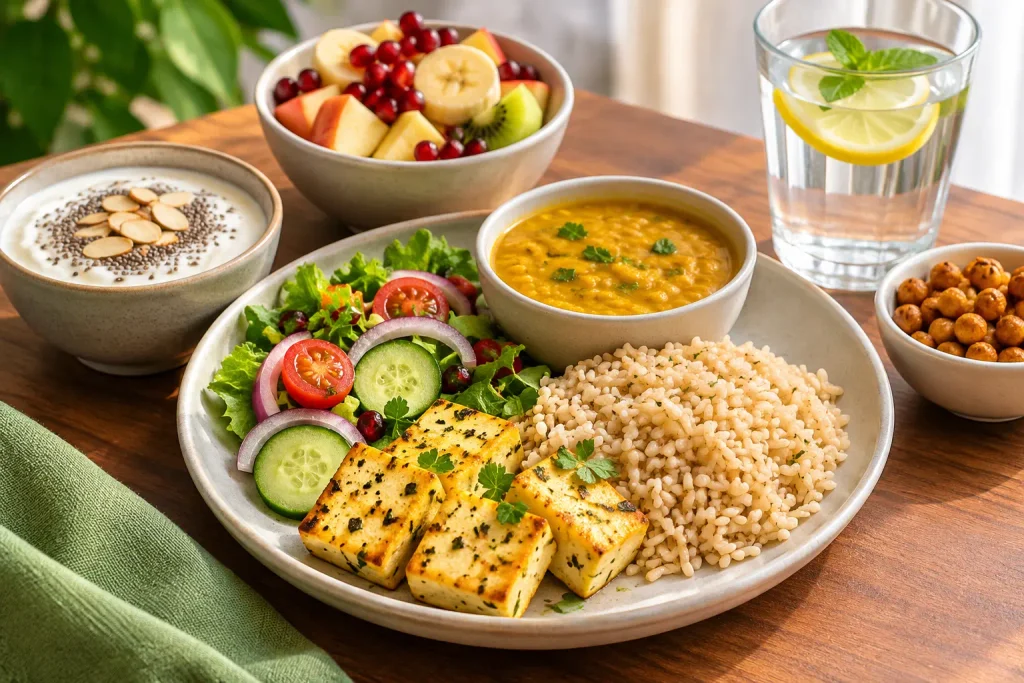
Healthy eating means regularly choosing a variety of unprocessed or minimally processed foods that give your body what it needs, while limiting excess salt, free sugars and unhealthy fats. It is a pattern across weeks and months, not one “perfect” meal.
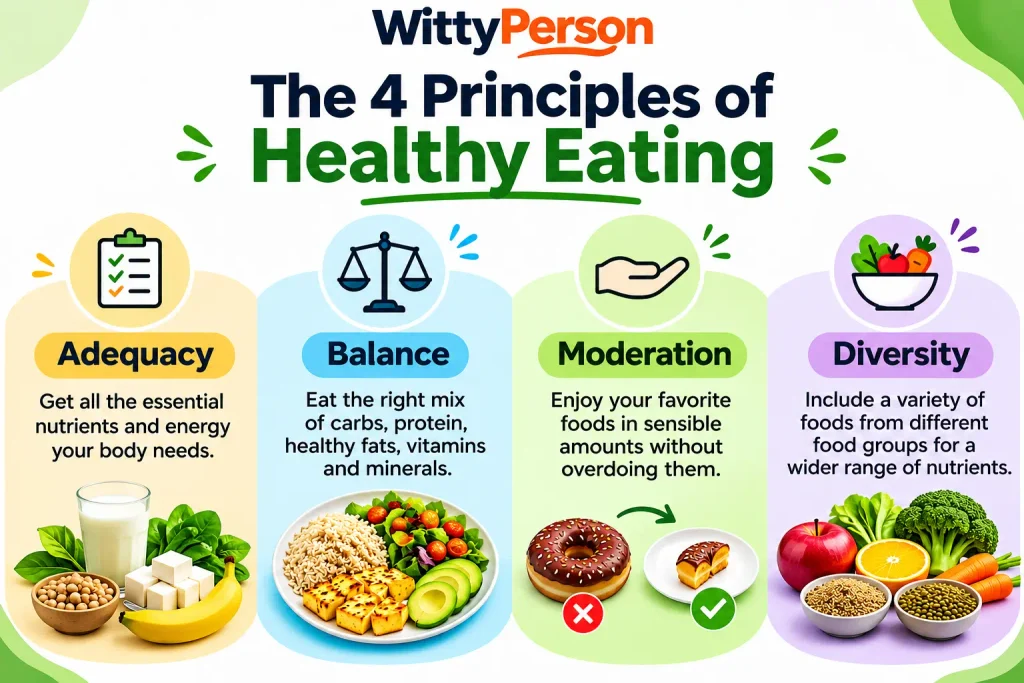
The World Health Organization (WHO) sums it up in four principles that work whether your plate is built around rice, wheat, millet or potatoes:
| Principle | What it means | Everyday example |
| Adequacy | Enough nutrients to prevent deficiencies, without overshooting | Beans or lean meat for iron; dark leafy greens for vitamin A |
| Balance | Energy eaten roughly matches energy used, with a mix of protein, fat and carbohydrate | A meal with grains, legumes and vegetables instead of just one of them |
| Moderation | Limit what harms you in excess | Treat fried, sugary and salty snacks as occasional |
| Diversity | Variety within and across food groups | Rotate lentils, chickpeas and beans; vary the colours of your vegetables |
Notice what is missing: banned foods, calorie counting and a single “superfood”. WHO also points out that the right mix depends on your age, activity level, culture and the foods available where you live.
Health Benefits of Healthy Eating
You make food choices several times a day, so diet is one of the few health factors you can influence constantly. Here is what the evidence supports, and where it is still developing.
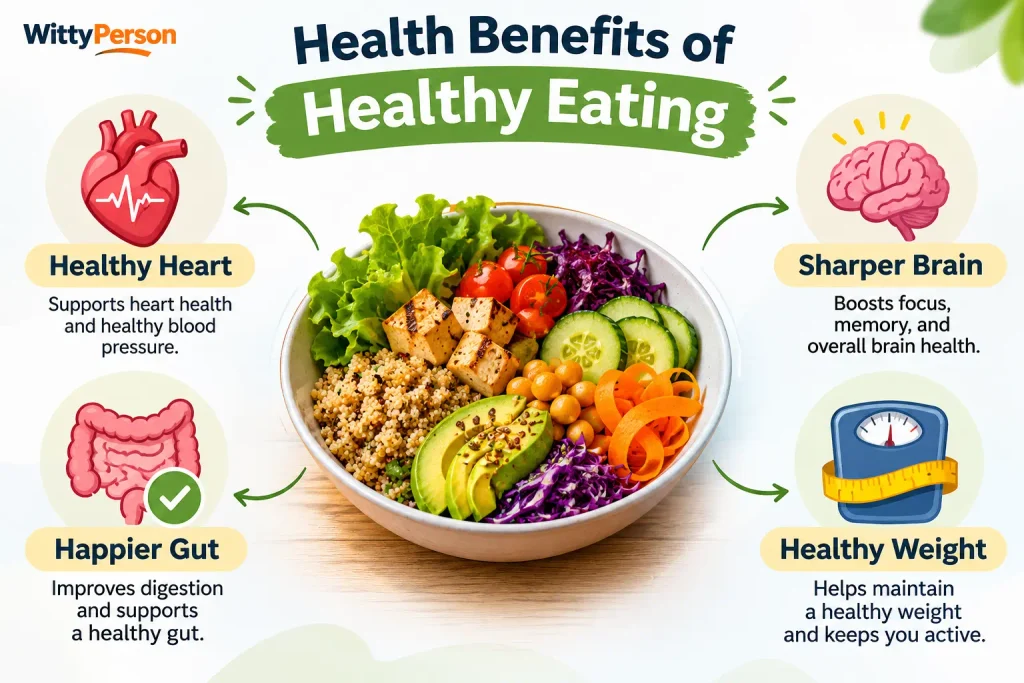
A Stronger Heart
Eating plenty of vegetables, fruit and fibre while cutting back on salt and saturated fat is linked with a lower risk of heart disease and stroke. WHO explains that high salt intake raises blood pressure, which can lead to cardiovascular disease, while potassium from fruit and vegetables can soften that effect.
Lower Risk of Diabetes and Some Cancers
WHO lists diabetes, heart disease, stroke and cancer among the noncommunicable diseases a healthy diet helps protect against. The key word is risk: food shifts the odds, it does not guarantee an outcome.
One useful detail from Medical News Today: lab studies link antioxidants to less cell damage, but human trials of antioxidant supplements remain inconclusive. Doctors advise checking with them before taking such supplements.
A Happier Gut
Fibre feeds the bacteria in your colon. A diet rich in vegetables, fruit, legumes and whole grains may reduce gut inflammation, and fermented foods such as yogurt, kimchi, sauerkraut and miso supply probiotics.
A Steadier Mood
A 2020 review found that diet can influence mood through blood sugar, immune activity and the gut microbiome. Patterns like the Mediterranean diet are linked with better mental health. Researchers stress that the mechanisms need more study, so treat food as one support, not a treatment. If low mood lasts, talk to a doctor or mental health professional.
Easier Weight Management
Vegetables, fruit and beans generally contain fewer calories than most processed foods, so a diet built on them makes it easier to stay in a healthy range without tracking every bite. A moderate weight also lowers the risk of type 2 diabetes, high blood pressure and some cancers.
Healthy Nutrition and Eating: Numbers Worth Knowing
You do not need to weigh every meal, but WHO’s daily guidance gives adults useful reference points:
| Target | WHO guidance | In practice |
| Fruit and vegetables | At least 400 g a day | Add some to every meal and snack |
| Fibre | At least 25 g a day, from food | Whole grains, pulses, vegetables, fruit |
| Free sugars | Under 10% of energy (about 50 g, or 12 teaspoons, on 2,000 calories); under 5% may add benefits | Check drinks, sweets and juice |
| Salt | Under 5 g a day | Look at stock cubes, sauces, bread and snacks |
| Total fat | 30% of energy or less | Favour fish, nuts and unsaturated oils |
| Saturated and trans fat | Under 10% and under 1% of energy | Go easy on butter, ghee, cream and fatty meat |
Free sugars include sugar added by manufacturers or cooks, plus the sugar in honey, syrups and fruit juice. They do not include the sugar inside a whole piece of fruit. Needs also shift with age, activity and health conditions, so a registered dietitian can tailor these numbers to you.
How to Start Healthy Eating: 6 Simple Steps
- Add before you subtract. Put one extra vegetable or fruit on every meal and snack. Reaching 400 g feels easier when it is spread across the whole day.
- Build meals from the main food groups. Combine a staple (rice, wheat, potatoes or cassava), legumes, vegetables and fruit, and a protein such as fish, eggs or milk. A common rule of thumb: fill about half your plate with vegetables and fruit.
- Choose whole over refined. Brown rice, oats, whole wheat and millet bring more fibre than their refined versions.
- Cut the hidden salt. In many countries most salt comes from processed foods, bread and condiments like stock cubes, soy sauce and fish sauce. Taste before salting, and season with herbs, spices and lemon.
- Rethink what you drink. Make water your default. Sugary drinks and even fruit juice carry significant free sugars, so whole fruit is the better pick.
- Use frozen and canned foods wisely. WHO says frozen and canned fruit and vegetables are good choices, provided they have no added sugar or excess sodium. Read the label.
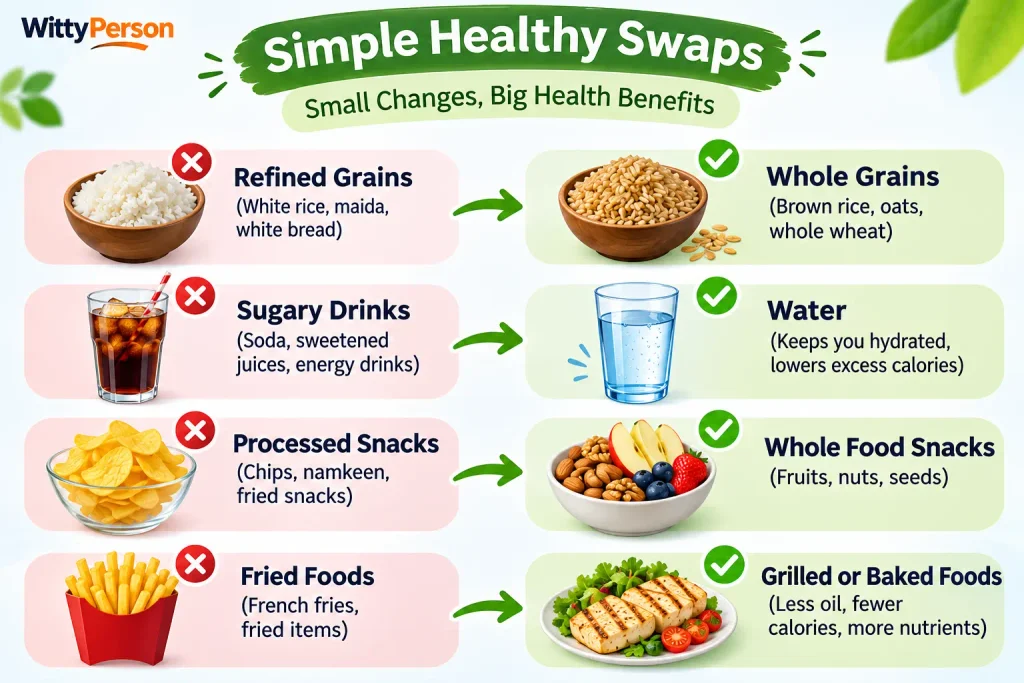
Big overhauls tend to fade within weeks. These steps ask for small changes you can keep.
What the Latest Guidelines Add
Official advice keeps evolving. The 2025–2030 Dietary Guidelines for Americans, released in January 2026, centre on real food: prioritise protein, vegetables, fruit and whole grains, and avoid highly processed foods and refined carbohydrates.
Some experts have questioned parts of the US advice, including how it handles saturated fat. That is why WHO’s global principles remain a steady anchor.
Common Healthy Eating Mistakes
- Cutting whole food groups without a medical reason. WHO says most people should still get roughly 45–75% of their energy from unrefined carbohydrates, and adults need at least 15% from fat.
- Leaning on supplements to fix a poor diet. WHO’s advice is to meet nutrient needs mainly through varied, nutrient-dense foods.
- Assuming “natural” means low sugar. Honey, syrups and fruit juice all count as free sugars.
- Chasing perfection. One rich meal does not undo a good pattern, and one salad does not fix a poor one.
Conclusion
Healthy eating is not a rulebook. It is four ideas, adequacy, balance, moderation and diversity, applied through ordinary choices: more plants, more whole grains, less salt and fewer sugary drinks.
Your next step is simple. Pick one of the six steps above and stick with it for a week, then add another. If you have a medical condition, are pregnant or are planning meals for a child, ask a doctor or registered dietitian for personalised advice.
Frequently Asked Questions
Can I still eat treats and eat healthily?
Yes. Moderation means limiting foods high in free sugars, salt and unhealthy fats, not banning them. What you eat most days matters more than what you eat once in a while.
Do I need to count calories?
Not necessarily. A diet built on vegetables, fruit, beans and whole grains helps many people stay within a healthy range without tracking. If you have a specific weight or medical goal, a dietitian can guide you.
Do I need supplements if I eat well?
A varied diet covers most nutrient needs for most people. Some people, such as those with a diagnosed deficiency, are advised to take specific supplements. Ask a doctor before starting.
Is healthy eating expensive?
It does not have to be. Frozen vegetables, canned beans, lentils, whole grains and seasonal produce are often affordable. WHO acknowledges that income and food prices shape what people can eat.
How much should children eat?
Needs are lower. WHO suggests at least 250 g of fruit and vegetables daily for ages 2–5 and 350 g for ages 6–9, and notes that childhood eating habits often last into adulthood.